

Climate Plans
In 2020 the Regional District of Okanagan-Similkameen (RDOS), in conjunction with other regional districts and Natural Resources Canada commissioned a study on how the climate in the Okanagan region will change, projected to the year 2050 and 2080. The study pointed out that the Okanagan region is projected to face significant climate changes by the mid- and late-21st century, posing challenges to ecosystems, communities, and the economy. Rising temperatures, with up to 50 additional days over 30°C annually by the 2080s in valley areas, will bring hotter summers, longer growing seasons, and warmer winters, while increasing health risks and threatening biodiversity. Shifting precipitation patterns, with wetter springs and autumns but drier summers, are expected to exacerbate risks of wildfires, droughts, flooding, and infrastructure strain. This report highlights the urgency of reducing reliance on fossil fuels and designing climate-resilient infrastructure to mitigate impacts. It provides detailed projections for temperature and precipitation changes, emphasizing proactive, climate-informed planning as more cost-effective than reactive measures. Community leaders are urged to collaborate on adaptive strategies to ensure a sustainable future for the Okanagan.
From 1971 to 2000 the RDOS valley bottom, where most of the inhabitants live, experienced on average 28 days with temperatures over 30 C. In 2050 that number is expected to increase to 33 days and in 2080 it will increase to 54 days. The hottest day in the RDOS valley bottom is now 35.8 C, which will increase to 40.2 by 2050 and 42.8 by 2080. These higher temperatures mean that significantly more energy will be required to cool homes and buildings. Winters will be warmer, which will impact snowpack, invasive species and agriculture.
The study states: “Climate change will cause significant changes in the region. Based on these changes, there is a need to plan for more intense and hotter fires, increasing water shortages, more smoke days, and a greater likelihood of spring flooding. These changes will have serious consequences on ecosystems, communities, and the economy.”

Community Climate Action Plan
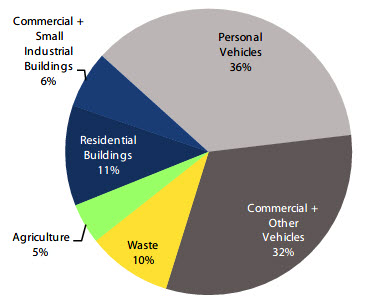
Chart shows Greenhouse gas emissions from the RDOS region (2007).
Climate change is a major challenge of our time and the Regional District of Okanagan-Similkameen (RDOS) is meeting it head-on. In 2011 the RDOS, in partnership with Keremeos, Oliver, Osoyoos, Penticton, Princeton and Summerland, developed a coordinated Community Climate Action Plan. The plan was created to provide guidance on future decisions -- reducing community energy use and greenhouse gas emissions. The plan covers current emissions and the consequences of carrying on with business as usual. In 2007 the RDOS area emitted 598,107 tonnes of CO2e -- 7.5 tonnes per person. The largest source of greenhouse gases within the RDOS is transportation, including both personal and commercial vehicles. The plan then lays out eight strategies for reducing greenhouse gases. These strategies include:
-
Higher energy efficiency standards for new homes and commercial buildings
-
Energy efficiency retrofits for existing buildings
-
Use of alternative energy
-
Energy efficient development -- where and how to build
-
Improve alternative transportation
-
Efficient vehicle use
-
Diverting solid waste from landfills
-
Handling of agricultural wastes
Each strategy leads to key actions to be implemented in the short term. Taking actions on these strategies is expected to reduce the RDOS region greenhouse gas emissions by 15% by 2023 and 35% by 2030, compared to a 2007 baseline. The success of the Community Climate Action Plan will be monitored by indicators including population in core areas, housing diversity and passenger vehicle travel. The coordinated Community Climate Action Plan allows the RDOS and its partners to make a strong start on a journey to a low carbon future.
Corporate Climate Action Plan
In 2011 The Regional District of Okanagan-Similkameen (RDOS) created a corporate Climate Action Plan. The plan was created to maintain focus on the RDOS’s climate commitment and guide decision making. A corporate plan covers just the activities of the RDOS organization -- in 2009 the RDOS operated 13 buildings, eight community and recreational facilities, four fire halls and a fleet of 14 vehicles. In 2009 these assets generated 586 tonnes of CO2e. By far the largest source of carbon emission was heating buildings by natural gas, generating 436 tons of CO2e. While a similar amount of energy was consumed by electricity, BC’s hydro-powered utilities generate very little carbon emission.
The Corporate Climate Action Plan proposed emission reduction measures, including energy efficiency measures, carrying out energy audits on all major capital projects and initiating green fleet management activities. Energy audits were carried out on five buildings in Oliver and Princeton. Recommendations included lighting retrofits, programmable thermostats and weather stripping. The core of the Corporate Climate Action Plan covered four areas: Buildings and Infrastructure, Fleet, Leadership and Engagement, and Regional Collaboration. Examples of actions under these headings include requiring evaluation of energy efficiency opportunities for capital projects and developing an idling reduction policy. The RDOS set a goal of reducing their greenhouse gas emissions by 10% by 2020. The RDOS is currently preparing new corporate and community climate action plans. The new corporate climate action plan is expected to be completed by the end of June 2025.
