

Reporting
The Regional District of Okanagan-Similkameen (RDOS) is deeply committed to sustainability and climate action. As a signatory of the BC Climate Action Charter, the RDOS is actively working to achieve address emission targets set by the province and federal government. RDOS reports its corporate emission to the province every year as a part of Local Climate Action Program – LGCAP (Previously known as Climate Action Revenue Incentive Program - CARIP). In addition, RDOS recently carried out community Emission Inventory to understand energy, associated cost, and emissions at community level.
Corporate Greenhouse Gas Emission Inventory
RDOS submit annual corporate emission to Climate Action Secretariat as a part of Local Government Climate Action Program. In 2023, the RDOS emitted a 1,399.03 tonnes of carbon dioxide equivalent (tCO2e) from the energy consumption by the corporate facilities, transportation and contracted services (traditional). The emission has increased by 42% which is primarily because of the improved tracking and expansion of the boundary.
Out of the total emission of 1399.03 tonnes, external services (contracted works) contribute to 67% of the emissions, and internal services (facilities, and fleet) contributes to 33% of the emission. Based on the chart below, corporate fleets are the major contributor to the corporation emission.
The RDOS is actively engaged in reducing its corporate emissions. In 2024 the RDOS replaced an HVAC rooftop unit at the 101 Martin Street location with a Dual-Fuel unit, an air-source heat pump backed up by a natural gas heater. The heat pump is a highly efficient source of heat and air conditioning and will reduce utility bills and carbon emissions. The RDOS is also reducing emissions from its vehicle fleet. Currently, the RDOS has an electric Ford E transit van and two Toyota hybrids. The RDOS is also working on a pilot initiative to provide electric vehicles for staff work-related travel. The RDOS has also conducted a fleet assessment to determine the best timeframe to transition the remaining vehicles to electric vehicles.

For the past reports, please follow the links provided below:
CARIP Reporting, 2010
CARIP Reporting, 2011
CARIP Reporting, 2012
CARIP Reporting, 2013
CARIP Reporting, 2014
CARIP Reporting, 2015
CARIP Reporting, 2016
CARIP Reporting, 2017
CARIP Reporting, 2018
CARIP Reporting, 2019 (waived due to COVID)
CARIP Reporting, 2020 (waived due to COVID)
RDOS LGCAP Survey Submission Report 2022
RDOS LGCAP Survey Submission Report 2023
Community Greenhouse Gas Inventory
The total energy consumption in RDOS communities is 11,960,017 GJ that accounts for 65,299 tonnes of CO2e emissions and a total of $349,334,172 in energy expenditure. The regional district has seen an increase in emission between 2007 and 2019 of 8.9% and 5.5 % in 2020. The emission trajectory shows that the region is on the trajectory to 10.4% lower in 2030 vs 2007 levels but well short of the provincial 40% reduction target.
Inventory and Business As Usual projections by Sector and Emission Source, in relation to New RDOS GHG Target.
The majority of emissions in RDOS in 2019 are due to the use of mobility fuels (gasoline & diesel), and natural gas at 50.8% and 28.4% in 2019, respectively. Waste contributes a moderate proportion at 12.8%, while electricity, propane, and heating oil are relatively minor, with a combined proportion of 8%. Proportions by emission source are similar between 2019 and 2020. What is notable is the absolute reduction in mobility fuels consumption of about 20,500 GJ or about 6% from 2019 to 2020.
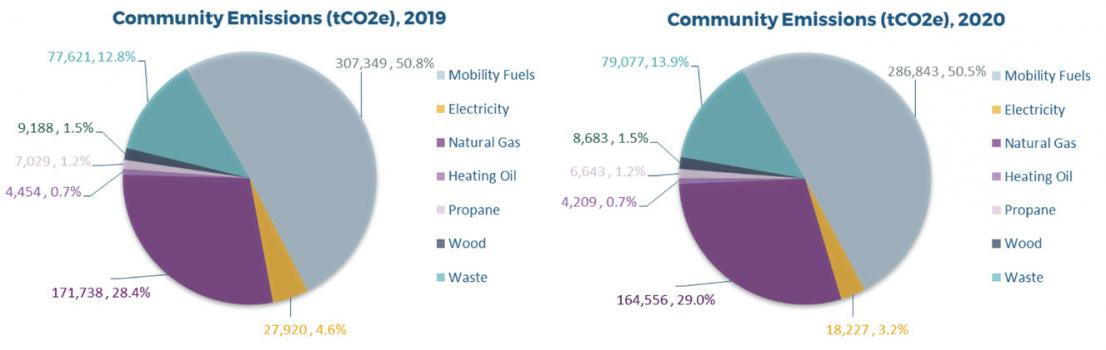
Pictures shows GHG Emissions by Fuel Type in 2019 and 2020
With regard to the energy cost, mobility fuels are the largest cost at approximately 49.1%, followed by electricity at 32.8%, and natural gas at 14.6%. Although electricity has very low GHG emissions, the reduction of energy consumption would still help manage community energy expenditures, as electricity is more expensive compared to natural gas (about 3 times more expensive per GJ).
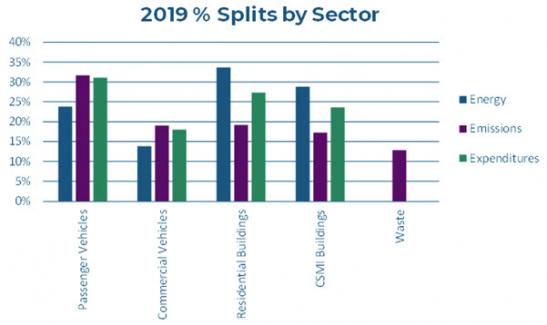 Pictures shows proportion of Energy, Emissions and Expenditures by% in 2019.
Some of the illustrative initiative that would be required to achieve the province and federal target in the RDOS suggested in the community emission inventory report are as follow:
-
Approximately 2,100 internal combustion engine vehicles convert to electric every year from now to 2030, which is about 30% of all new car sales. (For comparison, note that in 2017 there were 60 EVs registered in RDOS, rising by 545% to 387 in 2021.)
-
Approximately 760 commercial vehicles converting to a zero-carbon alternative each year from now to 2030, out of the estimated 8,900 vehicles that would be on the road in 2030
-
Approximately 3,400 residential buildings/accounts using natural gas converted to zero carbon heating every year from now to 2030. This is about 7.2% of the total number of dwellings estimated in RDOS, each year.
-
Approximate reduction of 27 kg of waste/year per person, based on tonnage of 51,361 t in 2021, and 56,869 t in 2007 (or corresponding reduction in GHGs)
