

Projects
Ongoing
Completed
- Zero Emission vehicle Infrastructure Program
- Fleet Transition Study
- Okanagan-Similkameen Electric Vehicle Infrastructure Gap Analysis
- Electric Vehicle Outreach and Awareness
- Solar Technology Feasibility Study Similkameen Recreation Centre
- Dual Fuel Rooftop Unit (RTU) Pilot
- Building Energy Efficient Homes Workshops
- Community Engagement
Regional Workshop on Energy and Climate Action
1. Development of Home Energy Retrofit Program for the Region
Buildings are the highest energy use sector but rank second after vehicles in terms of emissions and energy expenditure in the RDOS and City of Penticton. The region is committed to reducing greenhouse gas emissions by 80% by 2050, including measures such as retrofitting homes by replacing inefficient heating systems with high-efficiency alternatives. To meet these objectives and reduce energy usage and associated costs, approximately 1,500 single-family homes will need to be renovated in the region annually.
Aiming to build a program to support homeowners carrying out need assessment survey for energy retrofits. The survey gathered responses from 79 homeowners, revealing key insights into needs and challenges for home energy retrofit which revealed that
-
A majority of respondents live in detached homes (86%) and use natural gas as their primary heating source (48%), with electric systems as the main method for water heating (55%).
-
While 31.7% have already made energy improvements, a larger portion (36.7%) expressed interest in doing so.
-
Cost savings and emission reduction were found to be the primary motivators for retrofitting homes. However, high upfront costs (61.3%) and inflation (29.3%) remain barriers.
-
Many participants are looking for local government support, especially in financing options and energy evaluations, highlighting a need for accessible resources to facilitate sustainable upgrades.

Completed retrofit in the past five years
Building on the survey response, RDOS is collaborating with the City of Penticton to review various retrofit programming in the province, financing retrofitting homes, barriers, assess market and local government readiness, and develop retrofit programming model suitable for the region. The RDOS and the city of Penticton are currently reviewing the proposal submitted for the study.
2. RDOS Renewable and Electrification Feasibility Studies
With support from Natural Resources Canada through the Smart Renewables and Electrification Pathways Program (SREPs), Capacity Building Stream, the Regional District of Okanagan-Similkameen (RDOS) is conducting comprehensive energy audits, demand-side reviews, and renewable and electrification feasibility studies for 38 facilities within the Regional District of Okanagan-Similkameen and its municipal partners.
The project aims to assess building energy usage and explore feasible pathways toward NetZero, focusing on solar photovoltaic (PV) installations, energy reduction measures, and building electrification. The project also involves a detailed assessment of electrifying the Emergency Operations Center, supported by a 500kW electrical storage system, and a focused design for converting street lighting to electric vehicle (EV) charging stations in small communities.
Additionally, the project features a trainee program, where students from partner institutions and Indigenous groups will engage in project tasks, fostering a diverse and inclusive workforce. Data collected from this initiative will be widely disseminated, contributing to the knowledge base on the feasibility of electrification, decarbonization, and renewable energy solutions for community buildings in Canada. The findings will further support the development of innovative technologies, including emergency backup power systems for emergency operation centres and streetlight-to-EV charging conversions.
3. Custom Efficiency Study of Naramata Water System
Naramata Water System comprises three pump stations with 12 pumps with a total cumulative capacity of around 1200 hp. Also, these pump stations are among the highest electricity-consuming accounts and annual electricity bills. The total electricity consumption for these three accounts was around 1.8 million kWh and the annual bill was $220,000 in 2022.

Generalized Layout of Water System
With the support from Fortis BC through the Custom Efficiency Program, RDOS is conducting an efficiency study of the water system. The study will
- Describe the modifications that will achieve energy efficiency /demand reductions in the pump system including as applicable:
- Improvements in the efficiency of the motor, pump(define the “pump system” boundary),
- Change in operating profile,
- Pump controls,
- Changes in operating profile, and/or reduced system resistance,
- Improving power factors,
- Replacing the pump with high maintenance and/or poor reliability
- Prioritize various options, and recommend feasible ones for implementation.
- Prepare feasibility study of identified measures for savings energy and demands, energy cost, emission reductions, and estimate Return on Investment (ROI).
- Describe any risks (e.g. lost production, reliability) associated with the implementation of each energy conservation measure
- Describe the basic elements of a measurement and verification strategy for each recommended energy conservation measure.
- Quantify if any, GHG avoidance from the proposed energy conservation measure(s).
- Describe the analysis methodology and data with sufficient detail that another engineer, given sufficient time and resources, could approximately reproduce the results. Make note of any software and software version used in the analysis.
Update
Zero Emission Vehicle Infrastructure Program
The Regional District of Okanagan-Similkameen (RDOS) has been awarded a matching grant through Natural Resources Canada and CleanBC to expand the network of electric vehicle (EV) chargers in the region. Through this grant, the RDOS will install both public and workplace charging stations in eight locations identified by the EV chargers infrastructure gap assessment, which will promote EVs in the region and allow the RDOS to transition to electric fleets. The charger is owned by RDOS but operated by Flo.
Chargers will be installed at:
-
Main RDOS Office Car Park 101 Martin Street, Penticton – Six Level 2
-
Similkameen Recreation Centre 311 9th St, Keremeos, BC V0X 1N2 - Four Level 2 and Two Level 3
-
Tulameen Firehall and Ice Arena 132 1 St, Tulameen - One Level 2
-
Okanagan Falls Wastewater Treatment Plant, 1109 Willow St, Okanagan Falls - Two Level 2
-
Okanagan Falls – Kenyon Park – Two Level 3
-
RDOS Naramata Water Office - Two Level 2
-
1655 Reservoir Road, Penticton - Two Level 2
More information on the status of the ZEVIP project can be found at the RDOS page, and completed chargers can be found on the EV Charging Stations For The US And Canada | FLO
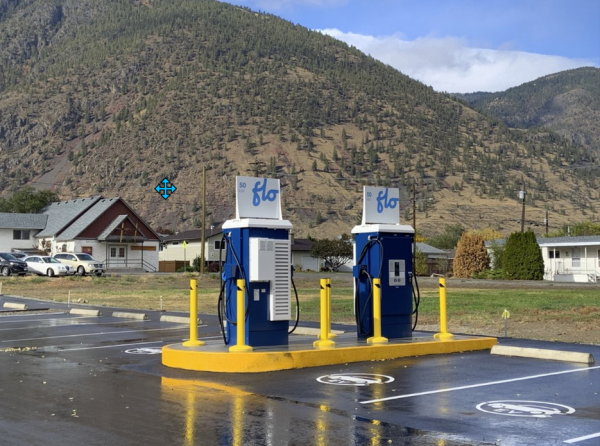
Public electric vehicle charging stations in Similkameen Recreation Centre
Fleet Transition Study
The RDOS completed a study to understand how its vehicle fleet can gradually move toward cleaner and more efficient options. The fleet includes 51 vehicles, most of which run on gasoline. As these vehicles reach the end of their service life, the RDOS is exploring how electric and hybrid vehicles could reduce fuel costs and greenhouse gas emissions.
The study compared several replacement options over the next 10 years, ranging from keeping the fleet as it is today to introducing more electric vehicles.

Cost and emission of various vehicle replacements scenarios
Key Findings
- Choosing more electric and hybrid vehicles can significantly reduce emissions compared with replacing vehicles with gas models.
- The most ambitious replacement option cuts emissions by about 21% more than business as usual.
- The cost difference between the cleanest scenario and doing things the same way is relatively small (about 6% higher over 10 years).
- Electric and hybrid vehicles are expected to lower operating costs over time.
Outcome
The study gives the RDOS a clear roadmap for planning future vehicle purchases. The RDOS has already introduced one fully electric van and two hybrid vehicles, and will use the study results to guide long-term decisions about replacing older vehicles.
3. Okanagan-Similkameen Electric Vehicle Infrastructure Gap Analysis
Status: Completed (February 2023)
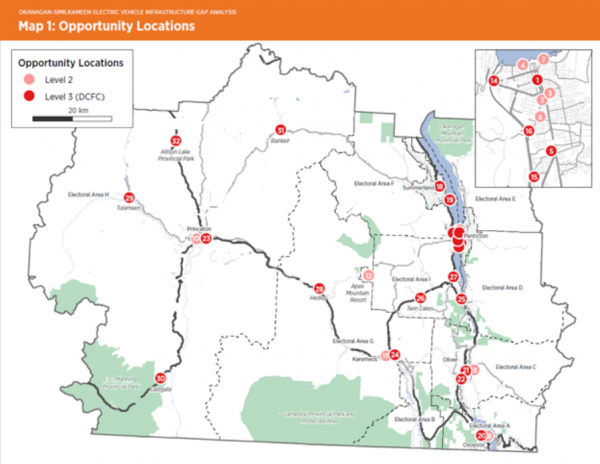
The RDOS partnered with local municipalities to study where new electric vehicle (EV) charging stations are most needed across the region. This “gap analysis” looked at the locations of existing chargers, how people travel, and where additional chargers would best support residents, visitors, and local businesses.
The study area included communities such as Penticton, Summerland, Osoyoos, Oliver, Keremeos, Princeton, Tulameen, and several rural communities.
What the Study Found:
-
Many residents in apartments or condos do not have access to home charging. Installing Level 2 chargers near multi-family housing would help fill this gap.
-
Level 3 fast chargers are most useful in areas with restaurants, shops, and along major travel routes, where drivers can quickly top up while travelling through the region.
-
The analysis identified 32 potential charging locations, including 12 sites suitable for Level 2 chargers and 20 suitable for Level 3 chargers.
Outcome:
The results of this study helped shape the RDOS’s successful funding application to the Zero Emission Vehicle Infrastructure Program (ZEVIP). The findings guided the placement of new chargers installed across the region, improving access to reliable EV charging for residents and visitors.
4. Electric Vehicle Outreach and Awareness
Status: Completed (June 2023)
In 2023, the RDOS partnered with Emotive BC to deliver electric vehicle (EV) outreach events in nine rural communities across the region. These sessions were held alongside local festivals and community gatherings and reached more than 1,300 residents.
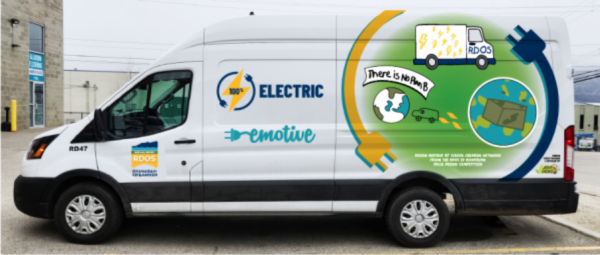
Participants received information on EV ownership, charging options, and operating costs, and had opportunities to ask questions directly. Local school children also took part in a decal design contest for the RDOS electric Ford E-Transit van, with artwork from the top three submissions incorporated into the final vehicle wrap.

5. Solar Technology Feasibility Study Similkameen Recreation Centre
Status: Completed (June 2024)
The RDOS completed a study to explore whether solar technologies could help reduce energy use at the Similkameen Recreation Centre. The assessment reviewed the building’s energy needs and examined several renewable energy options, including solar photovoltaics (electricity), solar air heating, and solar water heating.
The study found that the building has suitable roof and wall areas for solar installations. Based on technical and financial analysis, three options were identified for further consideration:
-
A 50-kW rooftop solar PV system
-
A solar water heating system
-
A solar air heating system
A solar water heating system could also offset a portion of the building’s hot water demand, supported by backup heating during winter and cloudy periods. These systems could help lower energy costs and reduce greenhouse gas emissions over time.

Dual Fuel Rooftop Unit (RTU) Pilot
The Regional District of Okanagan-Similkameen (RDOS) is invested in improving building energy efficiency, throughout the Okanagan-Similkameen and in RDOS owned buildings. The RDOS head office at 101 Martin Street in Penticton had three aging rooftop units, one of which failed in 2024. These units provided gas fired heating and refrigerated air cooling as well as ventilation.
Based on the assessment conducted by Prism Engineering, the RDOS replaced the units with a Dual-Fuel rooftop unit through FortisBC pilot program. Replacing the existing gas-fired rooftop units has avoided significant upgrades to the electrical system (note; it may be required to upsize wiring and breakers for other buildings), and increased climate resiliency of the building.
A Dual-Fuel unit consists of two parts, an air-source heat pump and a gas-fired heater. The heat pump is highly efficient and provides both heating and cooling. During the few winter days where the electric heat pump is not sufficient, supplementary heat is provided by the gas-fired heater. The Dual-Fuel RTU expected to reduce utility bills and carbon emissions. Measurement and verification of the system is underway to understand the impact of the system on energy bill and emissions

Dual Fuel RTU installed at RDOS’s Main Office building
7. Building Energy Efficient Homes Workshops
Status: Completed (April 2024)
In spring 2024, the RDOS hosted three “Building Energy Efficient Homes” workshops in Penticton, Okanagan Falls, and Keremeos. Funded through FortisBC’s Built Better initiative, the workshops introduced builders, homeowners, and community members to key concepts in modern home construction, including air-tightness, building envelope performance, mechanical systems, and upcoming changes to the BC Energy Step Code and Zero Carbon Step Code.
To make this information accessible to more residents, the RDOS partnered with Ecolighten Energy Solutions to produce a six-part video series based on the workshop content.
The full series is now available on the RDOS Energy Hub.
Watch the video series: [Click here]

8. Community Engagement
Community engagement plays an important role in supporting energy efficiency and emissions reduction efforts across the region. In 2024 and 2025, the RDOS hosted several workshops to bring together local governments, businesses, utilities, and community partners to share knowledge and encourage collaboration.
Regional Collaboration on Energy and Climate Action
The RDOS, in collaboration with the City of Penticton and FortisBC, organized a regional collaboration workshop in October 2024 to engage municipal partners and utilities in advancing energy efficiency and climate action within the region.
In October 2024, the RDOS worked with the City of Penticton and FortisBC to host a regional workshop focused on advancing energy and climate action. Representatives from Oliver, Penticton, Osoyoos, Princeton, Summerland, and FortisBC participated. The session included overviews of available programs, local case studies, and discussions on regional collaboration.

Representatives at the Workshop
The RDOS partnered with the City of Penticton and FortisBC to deliver a workshop for hotels and businesses. Topics included:
-
FortisBC programs for small businesses
-
Energy efficiency case studies
-
City of Penticton energy programs
-
Building envelope audits, air sealing and LED lighting upgrades
-
Rebates and incentives for commercial buildings
